 Premmerce
 How to Add a WooCommerce Filter by Category (3 Methods)

WooCommerce doesn’t add a category filter to your shop page by default. Out of the box, shoppers can sort the product grid by price or popularity, but they can’t narrow it down to a single category without one extra step from you.
They either scroll the whole catalog or give up and leave, and both cost you sales. A category filter, however, lets a shopper jump straight to the products they actually want, which means fewer abandoned sessions and a shorter path to checkout – especially on stores with a large or varied catalog.
The good news is that adding one is quick, and you’ve got three solid options. The right one depends on your theme and how much control you need:
- Native filter blocks – best for modern block themes, no plugin required.
- The Product Categories widget – best for classic themes that use widget areas.
- A dedicated filtering plugin – best when you want live AJAX filtering, combined filters, and SEO-friendly filtered pages.
The native options handle simple category filtering well. They stop short of live, no-reload filtering and combined filters, though, which is where a WooCommerce product filter plugin takes over. We’ll walk through all three so you can pick the one that fits your store.
Method 1: Using WooCommerce filter blocks (block themes)
If your store runs a block theme – the modern WordPress setup with full site editing – you can add a category filter directly in the editor, no plugin needed.
Not sure which type of theme you have? If Appearance shows an Editor option, you’re on a block theme.
- Go to Appearance > Editor to open the Site Editor.
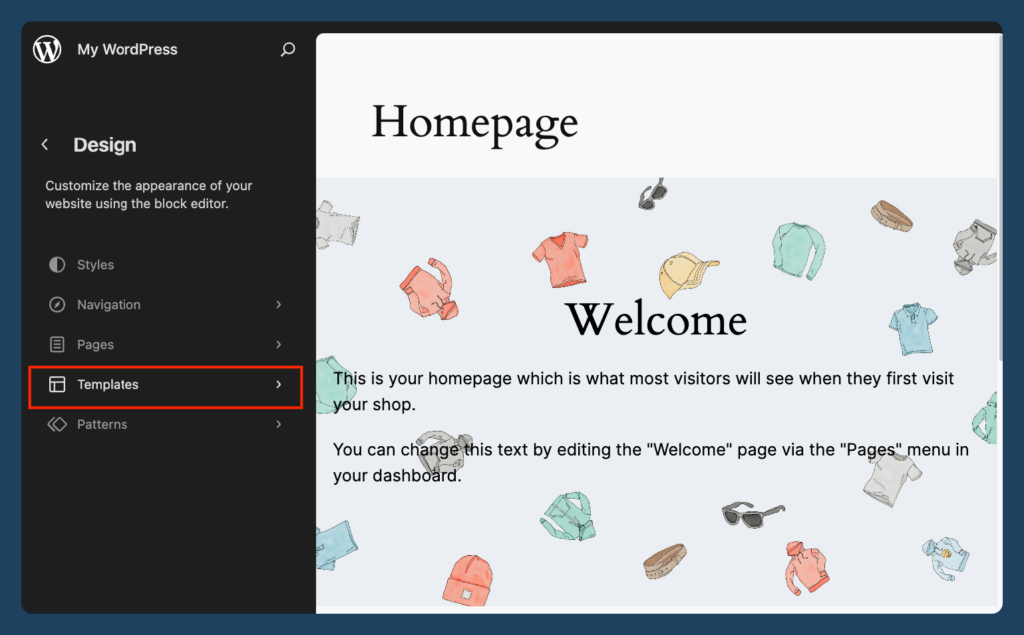
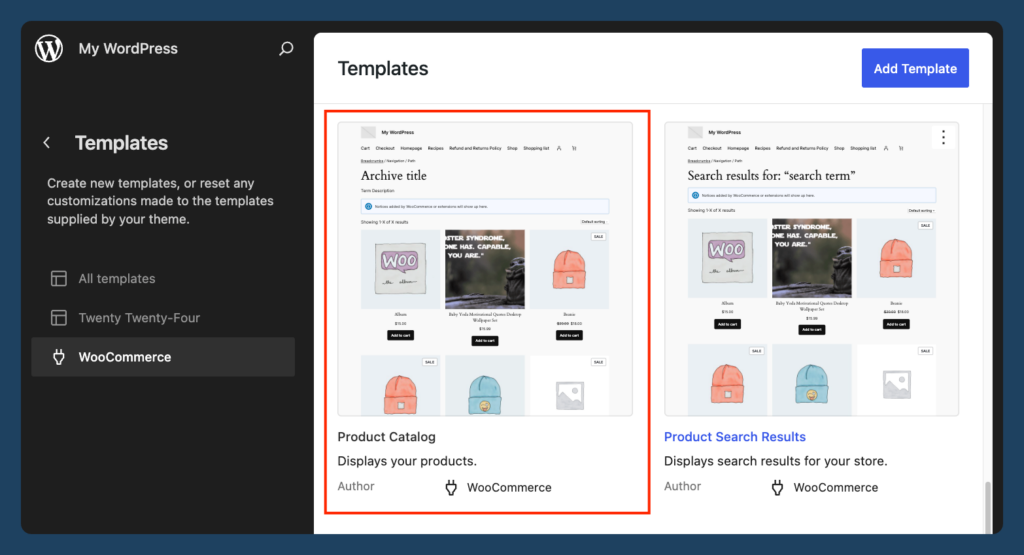
- Open the template you want to edit – usually the Product Catalog (shop) template.
- Click the + block inserter and search for the Filter Products block.
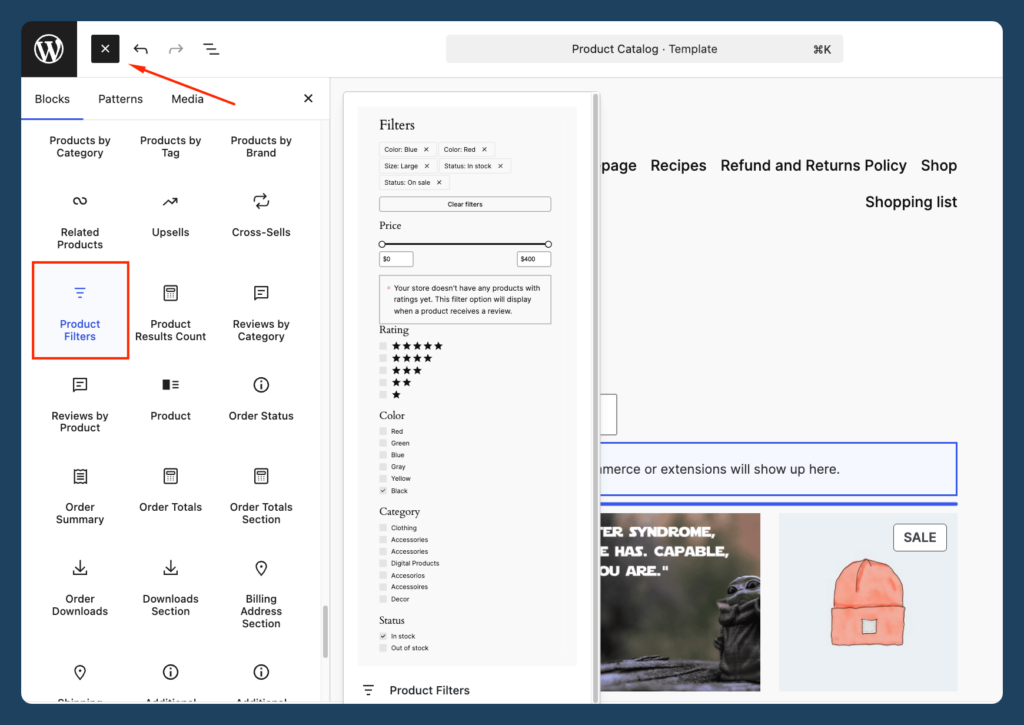
- Drag the block into your sidebar area or above the product grid.
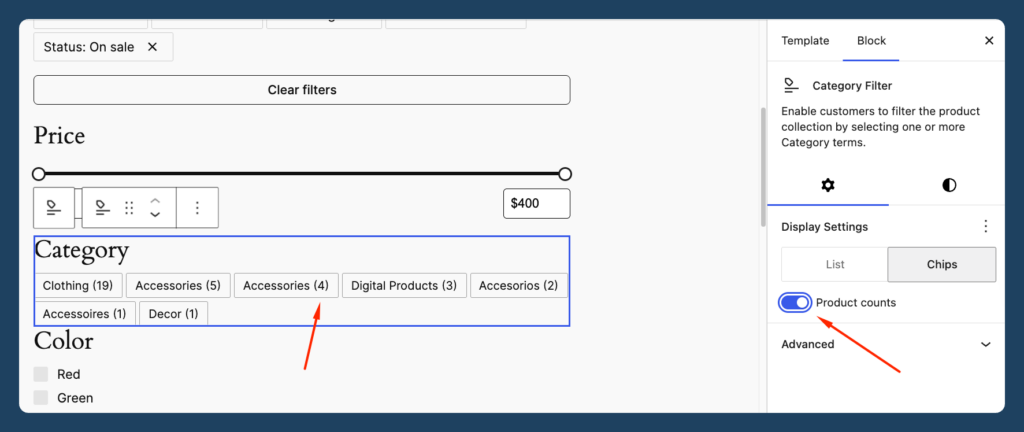
- In the block settings, set the display style to List or Chips.
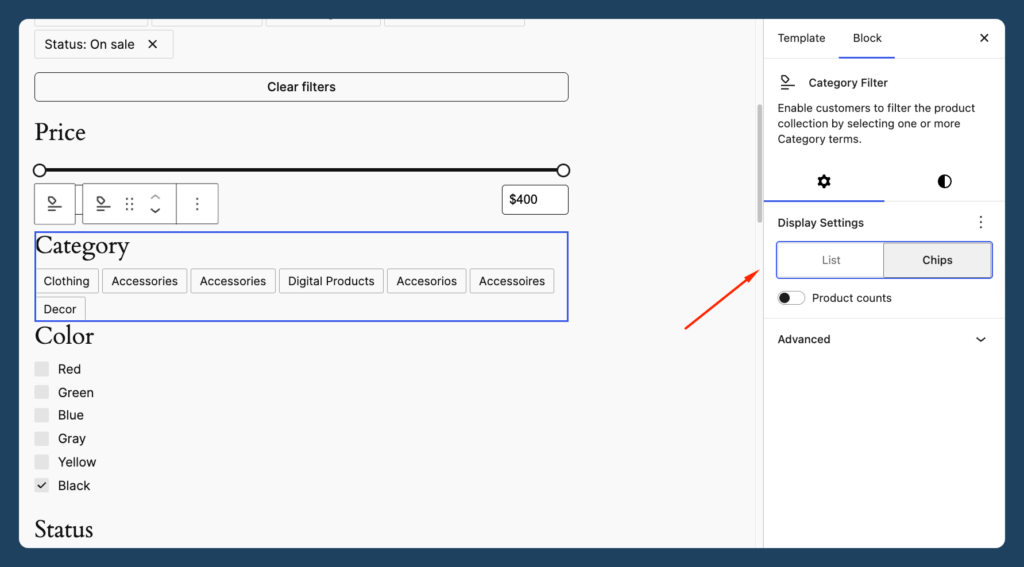
- Toggle Show product counts and Show hierarchy to match your catalog.
- Click Save.
Those display options change how the filter feels to shoppers. List shows your categories as a clickable list, while Chips displays them as compact tags that suit stores with a lot of categories. Show product counts adds the number of items beside each category, and Show hierarchy nests subcategories under their parents so a deep catalog stays readable.
Once you save, your shop page shows a working category filter that updates the product grid as shoppers select a category.
This method is quick and free, but it has limits. Styling control is basic; it’s only available on block themes, and combining it with price or attribute filters into one tidy panel isn’t straightforward. It also won’t create dedicated, SEO-friendly pages for filtered results, so a search like “blue running shoes” won’t land on its own indexable page. For a larger catalog that needs more, Method 3 covers the plugin route.
Method 2: Using the Product Categories widget (classic themes)
If your store still runs a classic theme with widget areas, the built-in Product Categories widget adds a category list or dropdown to your sidebar in a couple of minutes.
- Go to Appearance > Widgets.
- Find the Product Categories widget.
- Add it to one of your widget areas, such as the shop sidebar.
- Set your display options: enable “Show as dropdown”, “Show product counts”, and “Show hierarchy” as needed.
- Click Save.
Each option does something specific.
- “Show as dropdown” turns the category list into a single menu, which is ideal for narrow widget areas.
- “Show product counts” displays how many items sit in each category.
- “Show hierarchy” nests child categories under their parents.
Once saved, shoppers can pick a category to browse in that part of your catalog.
Important: The Product Categories widget is really category navigation, not a true filter. Selecting a category sends shoppers to that category’s archive page rather than narrowing the products they’re currently looking at, and it can’t be combined with price, tag, or attribute filters. If you want shoppers to filter products by attribute like size or color, filter by a custom taxonomy, or filter live without a page reload, you’ll want the plugin method below.
Method 3: Use a plugin for live AJAX filtering
The native methods cover the basics. For live AJAX filtering, multiple filter types in one place, and SEO-friendly pages for filtered results, you need a dedicated plugin like Premmerce WooCommerce Product Filter.
Let’s say you have a clothing store. A shopper after women’s pleated trousers shouldn’t have to scroll through your entire catalog to find them. With a full filter plugin, they can narrow by “Women’s Clothing”, then “Trousers”, then a price range, and watch the results update instantly – no page reloads, no dead ends. That’s the experience native filtering can’t quite deliver, and it’s what the plugin is built for.
The features that matter most for stores that have outgrown the native options:
- One sidebar widget displays all your filters – category, price, tag, stock, rating, or any attribute – so you’re not stacking clunky widgets just to give shoppers a few ways to narrow down.
- AJAX filtering updates the product grid instantly, with built-in caching that keeps pages fast and works alongside your existing caching plugin.
- Bulk-generate SEO-friendly pages from filter combinations, each with its own URL, H1, and meta – so filtered views like “on-sale dresses” can be indexed and pull in search traffic instead of sitting behind a query string.
- No coding required, and it’s compatible with major themes and page builders, including the block editor, Elementor, and Divi.
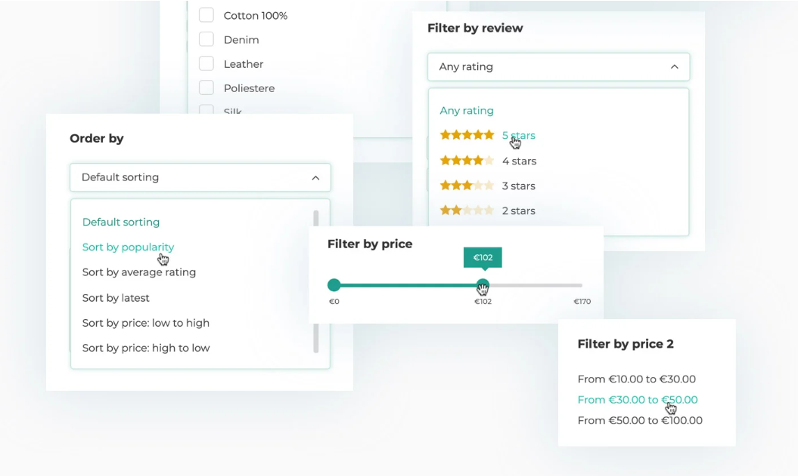
Setting up a category filter with the plugin is straightforward:
- Purchase and download the plugin from premmerce.com. In your WordPress dashboard, go to Plugins > Add New > Upload Plugin, choose the downloaded file, click ‘Install Now’, then ‘Activate Plugin’
- Enter your license key (found in your Premmerce account) and click ‘Agree & Activate License’
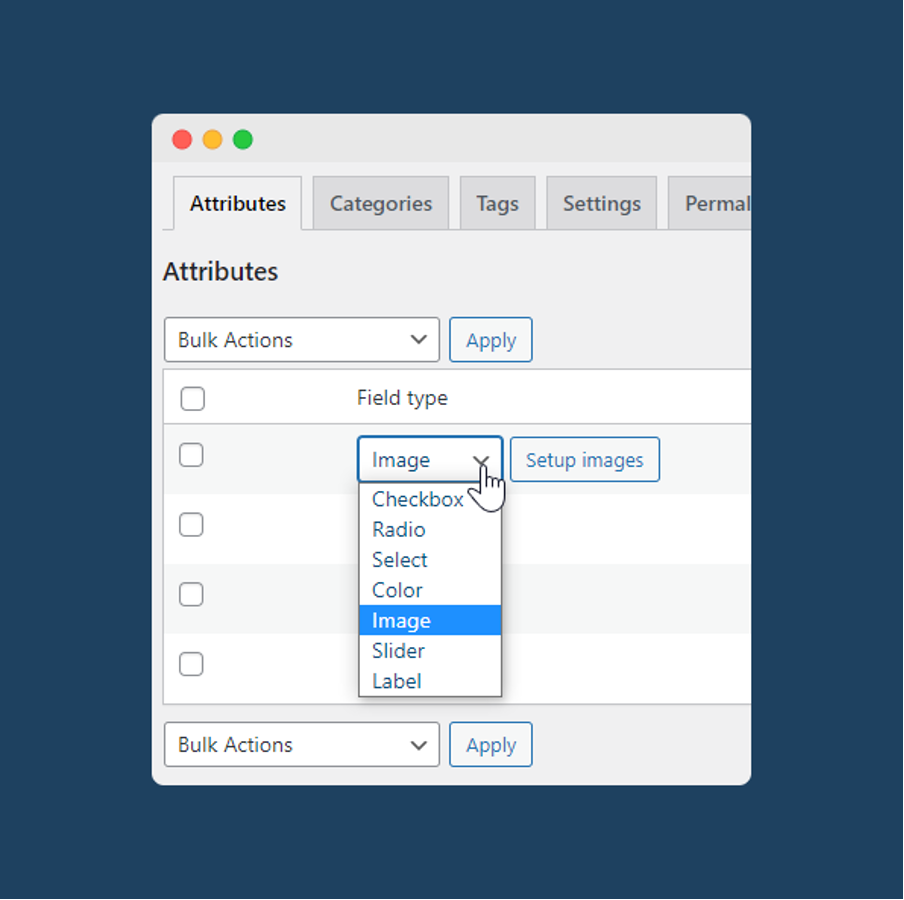
- In your WordPress dashboard, navigate to Premmerce > Product Filter > Attributes. Here you configure how categories appear to shoppers – choose the field type (checkboxes, radio buttons, thumbnail images, dropdown, etc.) and display style (scroll menu, collapsible, etc.)
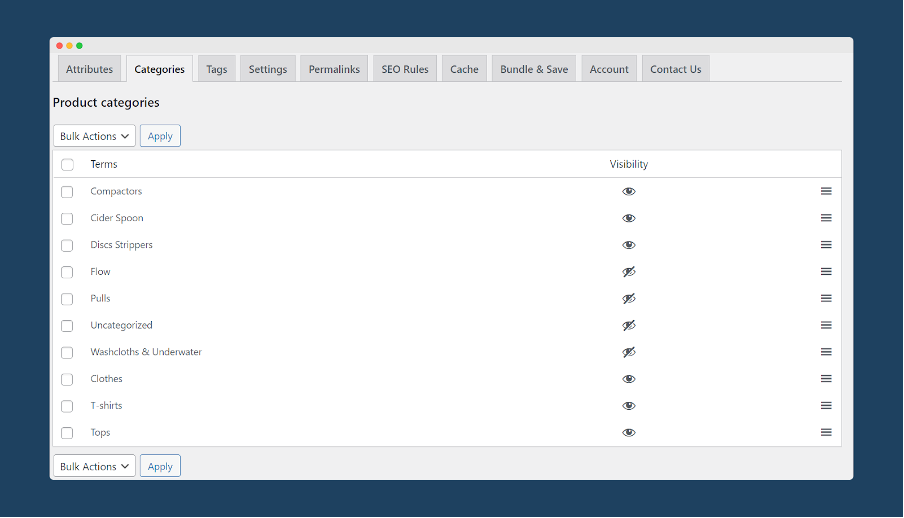
- Click the ‘Categories’ tab. Select which product categories customers can filter by – toggle visibility individually or use the bulk action dropdown
- Add the filter to your shop sidebar: go to Appearance > Widgets, find the ‘Premmerce Filter widget’, and drag it into your shop sidebar. Save.
- Preview your shop page – selecting a category filter should update results instantly without a page reload
Because every filter lives in one widget, you can let shoppers combine a category with a price range or a tag in the same view – something the native methods can’t do. Tag filtering, for example, works from the same widget, so adding a “filter by tag” option is just another checkbox rather than a separate build.
The plugin is available from $69.99/year for a single-site license, with a 30-day money-back guarantee.
Premmerce WooCommerce Product Filter
Get started giving your customers a better way to filter your products to increase site usability and revenue.
Which method is right for your store?
A quick way to decide between the three:
| Method | Best for | Live AJAX filtering | SEO-friendly filtered pages |
|---|---|---|---|
| Filter blocks (Method 1) | Block themes, simple catalogs | No | No |
| Product Categories widget (Method 2) | Classic themes, basic category navigation | No | No |
| Product filter plugin (Method 3) | Growing catalogs, combined filters, search traffic | Yes | Yes |
If you’re running a small store on a block theme and just need a simple category filter, the native block does the job. Once your catalog grows or you want shoppers to filter by more than one thing at a time, the plugin is the more reliable choice.
How to filter products by tag in WooCommerce
Tags work a lot like categories in WooCommerce, but they’re better for cross-cutting labels – think “waterproof”, “vegan”, or “summer” – that span multiple categories. Where categories tend to map to your store’s structure, tags describe a product’s features. Letting shoppers filter by tag helps them find items by what matters to them rather than by which department you filed them under.
The setup mirrors category filtering.
- On a block theme, add the Filter Products by Tag block the same way you added the category block in Method 1.
- On a classic theme, the Product Tags widget under Appearance > Widgets does the equivalent job, with the same dropdown and product-count options.
For a cleaner setup, the Premmerce Product Filter handles category and tag filtering from the same sidebar widget. A shopper can narrow to “summer dresses on sale” in one go, combining a category, a tag, and a sale filter without a single page reload – and adding the tag option is just another checkbox, not a separate build.
WooCommerce product category filter shortcode
WooCommerce includes a built-in shortcode for displaying product categories anywhere on your site. It’s useful for building a category grid on a landing page or inside a post:
[product_categories number="0" parent="0" orderby="name"]The attributes give you control over what shows and how:
- number – how many categories to show (0 shows all).
- parent – set to “0” for only top-level categories, or a category ID to show that category’s children.
- orderby – the sort order, such as “name” or “count”.
One thing to keep in mind: this is a display shortcode. It shows a clickable category grid and links each one to its archive page, rather than filtering products in place. It’s great for navigation, but it isn’t a live filter.
For an actual filter you can drop into a page or builder layout, the Premmerce Product Filter provides a dedicated filter shortcode that’s compatible with the block editor, Elementor, and Divi – giving you live, no-reload filtering wherever you place it.
Frequently asked questions
How do I add a category filter in WooCommerce without a plugin?
You can do it natively in two ways. On a block theme, add the Filter Products by Category block in the Site Editor. On a classic theme, add the Product Categories widget under Appearance > Widgets.
How do I show a simple category dropdown?
Add the Product Categories widget and enable the Show as dropdown option. This turns the category list into a single dropdown menu, which is ideal for tight sidebars.
Why don’t my categories show up in the filter?
A category only appears in a filter once it has at least one product assigned to it. Empty categories are hidden automatically.
Can WooCommerce filter products live without reloading the page?
The native widget doesn’t filter live – it reloads or navigates to a category page. For instance, no-reload filtering, you need a plugin with AJAX, such as the Premmerce WooCommerce Product Filter.
Choosing the right category filter for your store
Adding a category filter to WooCommerce comes down to your theme and how far you want to take it. Filter blocks are the fastest route on a block theme, the Product Categories widget covers classic themes, and a plugin unlocks live AJAX filtering, combined filters, and SEO-friendly filtered pages.
If your catalog is growing or you want shoppers to filter by category, price, and attribute in one place without a page reload, an advanced product filtering plugin is the most reliable way to get there.
Premmerce WooCommerce Product Filter
Get started giving your customers a better way to filter your products to increase site usability and revenue.
Comments

Ready to Get Started?
Join over 100,000 smart shop owners who use Premmerce plugins to power their WooCommerce stores.
Get started